
The Pomodoro Technique is a time management method that helps you work in short, focused sessions with regular breaks. It is designed to make tasks feel more manageable, improve concentration, and reduce procrastination.
Instead of trying to finish everything in one long stretch, you work in clear blocks of time. That structure makes it easier to start, stay focused, and keep your energy steady during the day. For the full system, return to our complete Pomodoro guide.
Table of Contents
How does the Pomodoro Technique work?
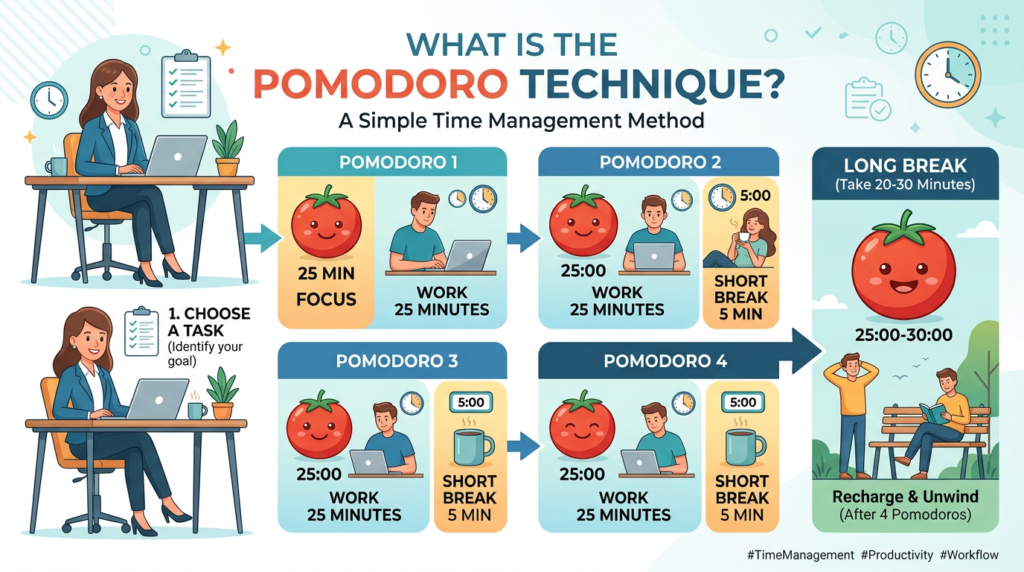
The classic Pomodoro Technique uses 25 minutes of focused work followed by a 5-minute break. After four sessions, you take a longer break to recover before starting the next cycle.
A typical session works like this:
- Choose one task before you begin.
- Set a timer for 25 minutes.
- Work only on that task.
- If you get interrupted, note it down and return to the task.
- Take a 5-minute break when the timer ends.
- Repeat the process.
- After four sessions, take a longer break.
One important detail is that a Pomodoro is meant to be a unit of focus. The goal is not just to run a timer, but to protect your attention while making progress in a controlled way.
What is the Pomodoro Technique used for?
People use the Pomodoro Technique to improve focus, manage time better, and reduce the feeling of overwhelm that comes with big tasks. It is especially useful when you know what you need to do, but keep delaying it.
It works well for:
- Studying.
- Writing.
- Coding.
- Reading.
- Admin work.
- Creative projects.
The method is useful because it gives each task a clear start and end point. That can make work feel less intimidating and easier to begin.
Why is the Pomodoro Technique effective?
The Pomodoro Technique is effective because it creates urgency without making the work feel endless. When you know you only need to focus for a short period, it becomes easier to begin.
It also helps because:
- It reduces procrastination.
- It limits distractions.
- It creates regular recovery time.
- It makes progress easier to track.
Another reason it works is that it gives your day a rhythm. That rhythm can help you stay productive without feeling mentally drained too early.
Example of using the Pomodoro Technique
Imagine you need to write an article, but the task feels too big to start. Instead of thinking about finishing the whole piece, you use one Pomodoro session to outline the introduction.
In the next session, you write the first section. Then you take a short break, come back, and write the next part. After four sessions, you stop for a longer break, check your progress, and decide what to do next.
This approach works because it turns a large, vague task into a sequence of small, manageable steps.
What is the Pomodoro Technique best for?
The Pomodoro Technique is best for tasks that benefit from focus, structure, and steady progress. It is especially helpful when the hardest part is getting started.
It is a strong fit for:
- Deep work.
- Repetitive tasks.
- Revision and exam preparation.
- Writing and editing.
- Tasks you tend to postpone.
It is also useful if you like seeing clear progress over time. Each completed session gives you a small win, which can make the whole day feel more manageable.
What is the Pomodoro Technique not best for?
The Pomodoro Technique is not ideal for every kind of work. Some tasks need long uninterrupted concentration, while others are too short or too reactive to fit neatly into timed blocks.
It may be less useful if:
- You work in a highly interruptive environment.
- Your task requires long creative flow.
- You already have a strong sense of time and pacing.
- Your work changes constantly during the day.
That does not mean the method does not work. It just means you may need to adapt it, use longer sessions, or choose a different approach for some tasks.
What are the steps of the Pomodoro Technique?
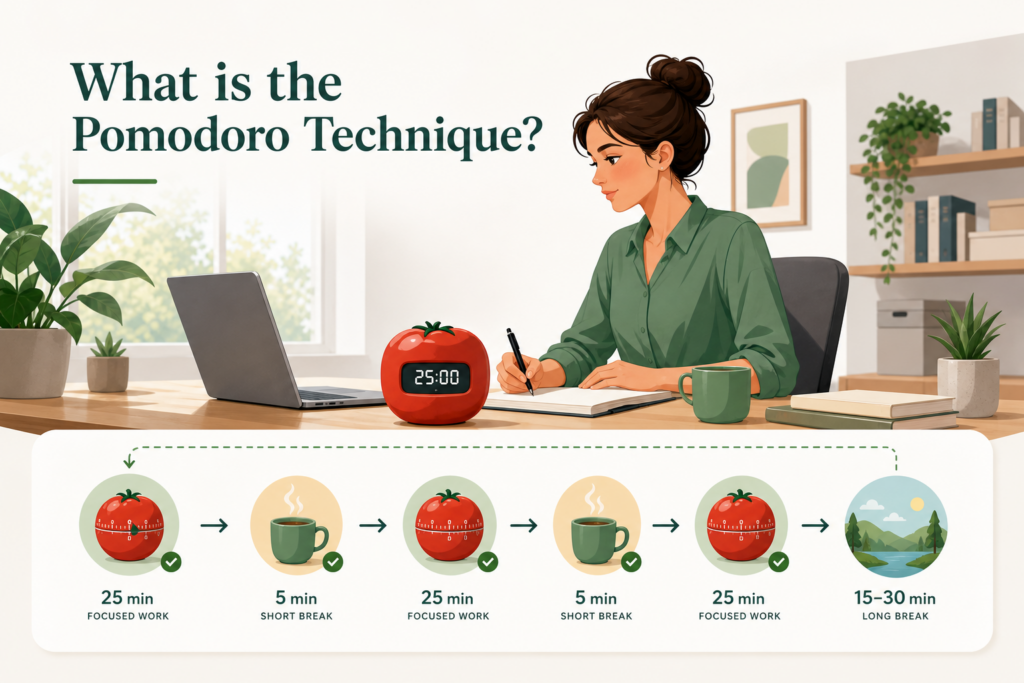
If you want to use the method correctly, the steps are simple:
- Choose a task.
- Set a timer for 25 minutes.
- Work without multitasking.
- If something interrupts you, note it and return to the task.
- Take a 5-minute break when the timer ends.
- Repeat the process.
- After four sessions, take a longer break.
One of the most useful parts of the technique is that it makes your work more intentional. You are not just “working until you feel done”; you are working in a system that helps you stay focused and recover regularly.
Why is it called the Pomodoro Technique?
It is called the Pomodoro Technique because “pomodoro” means tomato in Italian. The name comes from the tomato-shaped kitchen timer that inspired Francesco Cirillo when he created the method.
The name is unusual, but it is memorable. That helped the technique spread and made it easy to recognize.
Who invented the Pomodoro Technique?
The Pomodoro Technique was invented by Francesco Cirillo in the late 1980s. He created it while looking for a better way to study and organize his own time.
What began as a personal productivity experiment later became a widely used method for work, study, and creative projects. Its strength is that it is simple enough for almost anyone to try.
Conclusion
The Pomodoro Technique is a simple and practical way to manage time, focus, and energy. By alternating focused work with short breaks, it helps make difficult tasks easier to start and easier to finish.
If you want to try it, start small. Choose one task, set a timer, and complete just one Pomodoro today. If that feels useful, build from there by adding more sessions or adjusting the timing to fit your workflow.
Sources: Technique Pomodoro — Wikipédia,