
The best Pomodoro length depends on the type of work you are doing, how much focus it requires, and how easily you can stay engaged without losing momentum. The classic 25/5 format is a good starting point, but it is not the only useful option for time management, deep work, and focused task execution. If you are new to the method, start with our complete Pomodoro guide before choosing the best session length.
Table of Contents
What is the best Pomodoro length?
There is no single best Pomodoro length for everyone. The most effective session length is the one that helps you stay productive, keep your attention on the task, and move through your work without unnecessary friction. Some people do best with short, frequent focus intervals. Others prefer longer blocks that give them enough time to enter a flow state and do meaningful work before the break.
The classic 25-minute work block followed by a 5-minute break is still the most common starting point. It is simple, easy to repeat, and especially useful if you are new to Pomodoro, easily distracted, or working on tasks that are small and clearly defined. For many people, it provides just enough structure to reduce procrastination without making the session feel heavy.
Why session length matters
A Pomodoro session is only useful if it gives you enough time to make real progress on a task. If the block is too short, you may spend most of it getting started, settling into the work, and rebuilding concentration. If it is too long, you may lose mental energy, drift away from the task, or feel fatigue before the timer ends.
The goal is to find a work interval that feels realistic and still helps you stay on track. Different tasks require different levels of attention, different levels of cognitive effort, and different rhythms of rest and recovery. Reading, answering emails, writing code, and drafting a report do not all benefit from the same focus block.
When to use shorter sessions
Short sessions can be useful when the task is light, repetitive, or hard to start. If you tend to procrastinate, a shorter work block can reduce resistance and make it easier to begin. This is often the case for emails, simple revision, small corrections, or cleanup work.
Shorter formats also work well when your day is fragmented by interruptions or when you are working in a busy environment. If you expect frequent context switching, a 25-minute or 30-minute block may fit better than a longer one. In that case, a shorter timer can help you protect your attention and keep the work moving.
Short sessions are also a good option if you are still building the habit. A shorter focus sprint often feels less intimidating, and that makes it easier to stay consistent over several days.
When to use medium sessions
Medium formats such as 40/10, 45/10, 50/10, 60/5, and 60/10 are often a strong middle ground. They give you more time to settle into the task while still keeping the structure clear. Many people find these lengths more comfortable once they are already familiar with Pomodoro and want a smoother balance between focus and recovery.
These formats are often useful for:
- writing.
- planning.
- reading.
- editing.
- coding.
- problem solving.
If a task needs a little more concentration but does not require a full deep-work block, a medium session is often the best option. It gives you enough time to enter a productive rhythm without making the block feel endless. For a lot of people, this is the sweet spot between too short and too demanding.
When to use longer sessions
Longer sessions such as 80/20, 90/20, or 90/30 are better for deep work. These are useful when the task is complex, the work requires sustained concentration, or stopping too often would interrupt your flow and reduce quality.
Longer blocks are often a good fit for:
- research.
- long-form writing.
- complex coding.
- design work.
- strategic planning.
- detailed analysis.
These formats are not ideal for everyone, and they usually work best after you already have some experience with the method. If you try them too early, they may feel too heavy, too demanding, or too difficult to maintain over several cycles.
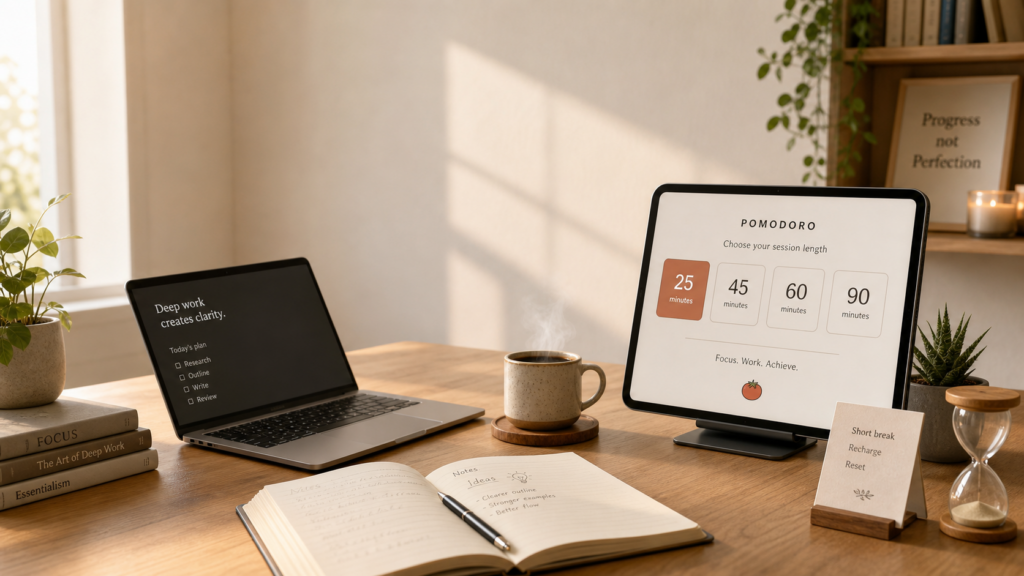
What is the maximum Pomodoro time?
There is no fixed maximum Pomodoro time. The method is flexible, and the longest useful session depends on the task, your attention span, and how well you can maintain quality until the end. Some people stay close to the classic 25-minute cycle, while others extend their focus blocks to 45, 50, 60, or even 90 minutes for deep work.
The right maximum is not the longest time you can tolerate. It is the longest time that still helps you stay focused, productive, and mentally fresh enough to continue after the break. If the block starts losing value, it is probably too long.
A practical range looks like this:
- 25 to 30 minutes for beginners and quick tasks.
- 40 to 50 minutes for writing, coding, and medium-complexity work.
- 60 to 90 minutes for deep work, research, or demanding creative tasks.
A practical way to choose
If you are not sure which length to use, start with 25/5 and observe how it feels. Ask yourself:
- Do I finish the block comfortably?
- Do I still have focus at the end?
- Do I need more time to get into the task?
- Do I feel rushed, scattered, or mentally tired?
If the block ends before you have built momentum, try a longer session. If you feel drained or lose concentration before the timer ends, try a shorter one. The best length is the one that helps you work consistently without creating unnecessary pressure.
A simple rule of thumb:
- use shorter sessions when you need momentum,
- use medium sessions when you need balance,
- use longer sessions when you need deep concentration.
Suggested session lengths by task
Here is a simple guide:
- 15 to 20 minutes: very light tasks, admin work, emails.
- 25 to 30 minutes: beginners, study, simple focus tasks.
- 40 to 50 minutes: writing, coding, medium-complexity work.
- 60 minutes: structured one-hour work sessions.
- 80 to 90 minutes: deep work, research, or demanding creative tasks.
This is only a starting point. You may find that one type of task works better with a different rhythm, and that is completely normal in a real productivity workflow.
How to test your ideal length
The easiest way to find your best Pomodoro interval is to test a few versions over several days. Pick one length, use it consistently, and note how you feel near the end of each session.
A good test looks like this:
- Day 1 to 2: try 25/5.
- Day 3 to 4: try 45/15 or 50/10.
- Day 5 to 6: try 60/10 or 80/20 if the work is more demanding.
What matters most is not the timer itself, but whether the timer helps you stay focused, avoid mental fatigue, and complete useful work. The right session length is the one you can actually repeat in your daily routine.
Final recommendation
For most people, the best way to begin is with 25/5 or 50/10. These two formats give you a practical comparison: one is short and easy to sustain, the other gives you more room to work. After a few days, you can adjust based on how focused you feel and how much progress you make.
The right Pomodoro length is not the one that sounds most efficient on paper. It is the one you can actually use every day to support your attention, your workflow, and your long-term productivity.
Sources: Research on Pomodoro breaks and effort regulation, Pomodoro® Technique website